Album StoryTrack 03
How Radiohead made OK Computer in an old English country house
Radiohead recorded much of their third album in a historic house that belonged to the actress Jane Seymour.
- Artist
- Radiohead
- Album
- OK Computer
- Year
- 1997
- Country
- UK
- Genre
- Alternative Rock
- Reading time
- 2 min read
Halfway through OK Computer, over a faint piano, a flat computer voice reads out a list of instructions for a better life. In 1997 it sounded like satire.
01The context
Their second album, The Bends (1995), was a success, but many still saw Radiohead as the band behind “Creep”. Years of touring left the band exhausted. In 1997 Thom Yorke described flying to a different country every day and going in and out of X-ray machines.
Travel found its way into the new songs. Yorke wrote less about himself and more about the world around him, about society, technology and consumerism.
02How the album was recorded
Much of the album was recorded at St Catherine’s Court, a historic manor house near Bath owned at the time by the actress Jane Seymour. The band recorded in different parts of the house for the atmosphere. Several songs were made in the ballroom, and the acoustic guitar for “Exit Music” was recorded on a stone staircase.
Nigel Godrich, who had worked with the band as an engineer, produced the record together with them. They tried unusual time signatures and keyboards such as the Mellotron.
03Hidden details
The voice on “Fitter Happier” came from the text-to-speech feature of an Apple Macintosh. “Exit Music (For a Film)” was written for Baz Luhrmann’s 1996 film Romeo + Juliet and plays over its end credits.
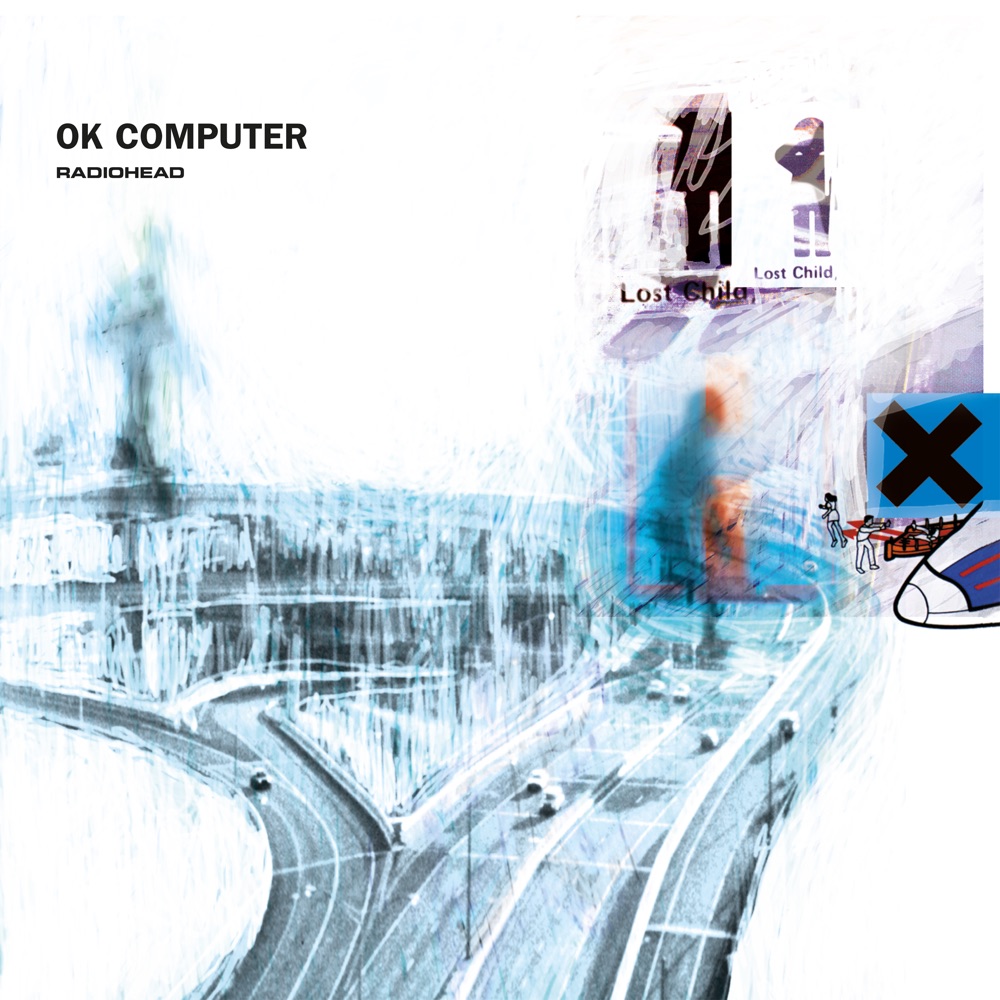
Stanley Donwood and Yorke made the artwork together, as computer collages built from their sketchbooks and found images, with stick figures shaking hands.
04The album’s legacy
OK Computer won the Grammy for Best Alternative Music Performance. In 2015 it was added to the US Library of Congress National Recording Registry, and in 2020 Rolling Stone placed it at No. 42 on its list of the 500 greatest albums of all time. In 2000 the band turned to a more experimental, electronic sound with Kid A.
Sources & References (16)
- 1.500 Greatest Albums: Radiohead’s Futuristic Breakthrough ‘OK Computer’ (opens in a new tab). Andy Greene, Rolling Stone, 2020
- 2.Thom Yorke on OK Computer (opens in a new tab). Jim Irvin, MOJO (1997 interview, republished 2025)
- 3.Vinyl Icons: Radiohead, OK Computer (opens in a new tab). Johnny Sharp, Hi-Fi News, 2021
- 4.Radiohead: OK Computer (page 2) (opens in a new tab). Johnny Sharp, Hi-Fi News, 2021
- 5.Radiohead: OK Computer, Production Notes (opens in a new tab). Johnny Sharp, Hi-Fi News, 2021
- 6.Radiohead: OK Computer, Alternate Format Discography (opens in a new tab). Johnny Sharp, Hi-Fi News, 2021
- 7.The Doors, Radiohead, Joan Baez Added to National Recording Registry (opens in a new tab). Daniel Kreps, Rolling Stone, 2015
- 8.Radiohead Deliver ‘OK Computer’’s Manifesto With ‘Fitter Happier’ (opens in a new tab). Annie Zaleski, Ultimate Classic Rock, 2022
- 9.Radiohead Give Star-Crossed Lovers Their ‘Exit Music’ (opens in a new tab). Bryan Wawzenek, Ultimate Classic Rock, 2022
- 10.‘OK Computer’: 50 geeky facts about Radiohead’s iconic 1997 album (opens in a new tab). Larry Bartleet, NME, 2017
- 11.Radiohead: ‘We were spitting and fighting and crying…’ (opens in a new tab). Stephen Dalton, Uncut, 2016
- 12.Thirty years of creative collaboration: Donwood, Yorke & Radiohead (opens in a new tab). Ashmolean Museum, University of Oxford
- 13.St Catherine’s Court (listing 1232265) (opens in a new tab). Historic England, via British Listed Buildings
- 14.Jane sells her beloved manor house after neighbour protests (opens in a new tab). HELLO!, 2007
- 15.40th Annual Grammy Awards (1998) (opens in a new tab). Recording Academy, grammy.com
- 16.Radiohead: GRAMMY Awards history (opens in a new tab). Recording Academy, grammy.com
Spotted an error? Tell us →