Album StoryTrack 02
Two sessions, almost no rehearsal and the bestselling jazz album of all time
Miles Davis came to the studio with a few sketches and an idea about scales. His musicians had not seen the material before.
- Artist
- Miles Davis
- Album
- Kind of Blue
- Year
- 1959
- Country
- USA
- Genre
- Modal Jazz
- Reading time
- 2 min read
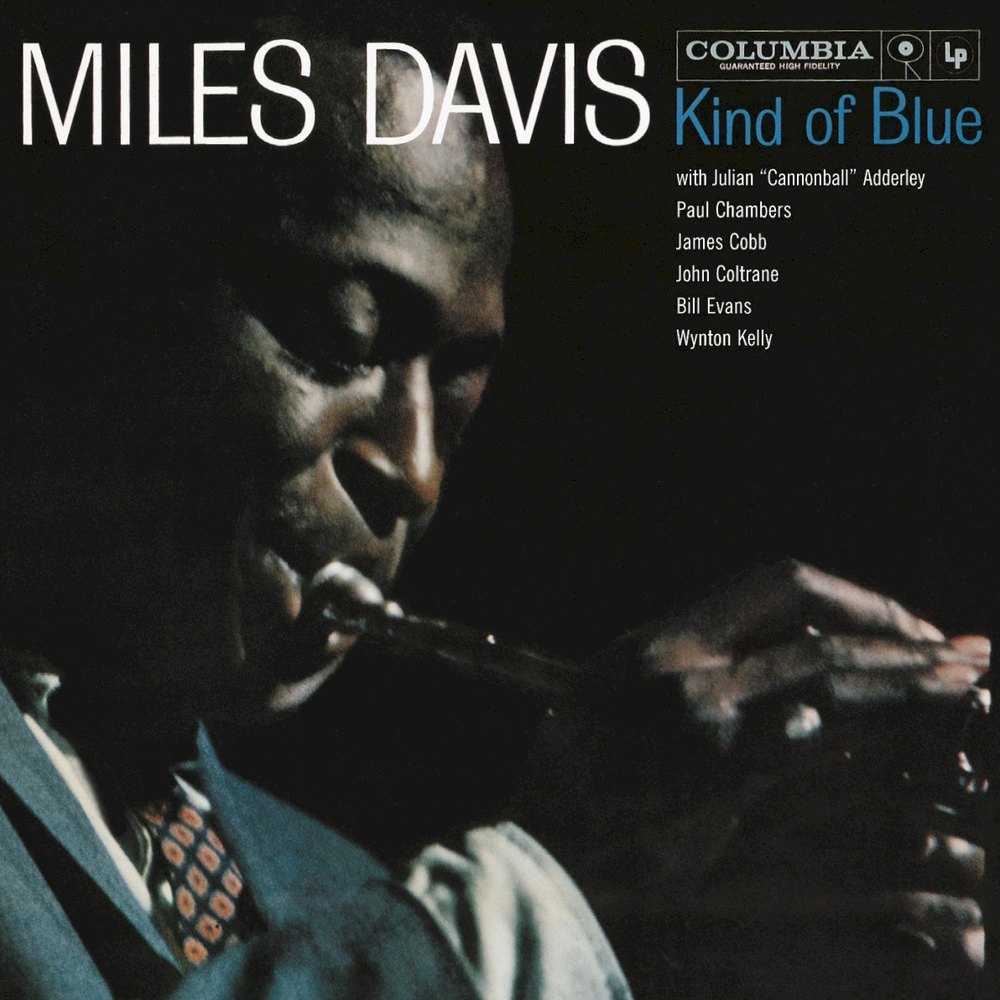
The musicians arrived at Columbia’s 30th Street Studio in New York without knowing what they would record. Davis wanted it that way. He believed that the first time you play something, you play it most honestly.
01The context
By the late fifties bebop had pushed jazz towards faster tempos and more complex chord changes. Davis wanted more space. He asked his musicians to improvise over scales, or modes, that could last for many bars instead of racing through chords.
The sextet was John Coltrane and Cannonball Adderley on saxophones, Paul Chambers on bass and Jimmy Cobb on drums. Bill Evans, who had recently left the band, came back for the sessions. Wynton Kelly played piano on “Freddie Freeloader”.
02How the album was recorded
The album was recorded on 2 March and 22 April 1959. Davis brought short sketches of scales and melodies instead of full arrangements. Almost every track on the final album was a first complete take.
The studio was a converted church with a warm natural reverb, and you can hear it on the record in the way the horns and cymbals ring out.
I didn’t write out the music for Kind of Blue, but brought in sketches for what everybody was supposed to play.
03The unusual story
For more than thirty years the first side of Kind of Blue played slightly fast. One of the tape machines at the first session ran slow, so at normal playback speed the music came out higher, about a quarter tone sharp.
Musicians who tried to play along noticed that their instruments did not match the record. The problem was fixed in a reissue in the early nineties, and many listeners heard the album at its real pitch for the first time.
04The album’s legacy
Kind of Blue is often called the best-selling jazz album of all time and is certified multi-platinum in the United States. Its influence reaches rock, ambient music, film scores and hip-hop.
Sources & References
- 1.Kind of Blue: The Making of the Miles Davis Masterpiece (opens in a new tab). Ashley Kahn, Da Capo Press, 2000
- 2.Miles: The Autobiography (opens in a new tab). Miles Davis & Quincy Troupe, Simon & Schuster, 1989
- 3.Kind of Blue, 50th Anniversary Collector’s Edition notes (opens in a new tab). Columbia/Legacy, 2008
Spotted an error? Tell us →