Album StoryTrack 10
A record from Bahia, a classical conductor and a choir of friends
In 1966 Baden Powell and Vinicius de Moraes recorded Os Afro-Sambas with a classically trained conductor and a choir full of friends. Decades later, by then an evangelical Christian, Baden decided to stop playing some of the songs.
- Artist
- Baden Powell & Vinicius de Moraes
- Album
- Os Afro-Sambas
- Year
- 1966
- Country
- Brazil
- Genre
- Samba
- Reading time
- 3 min read
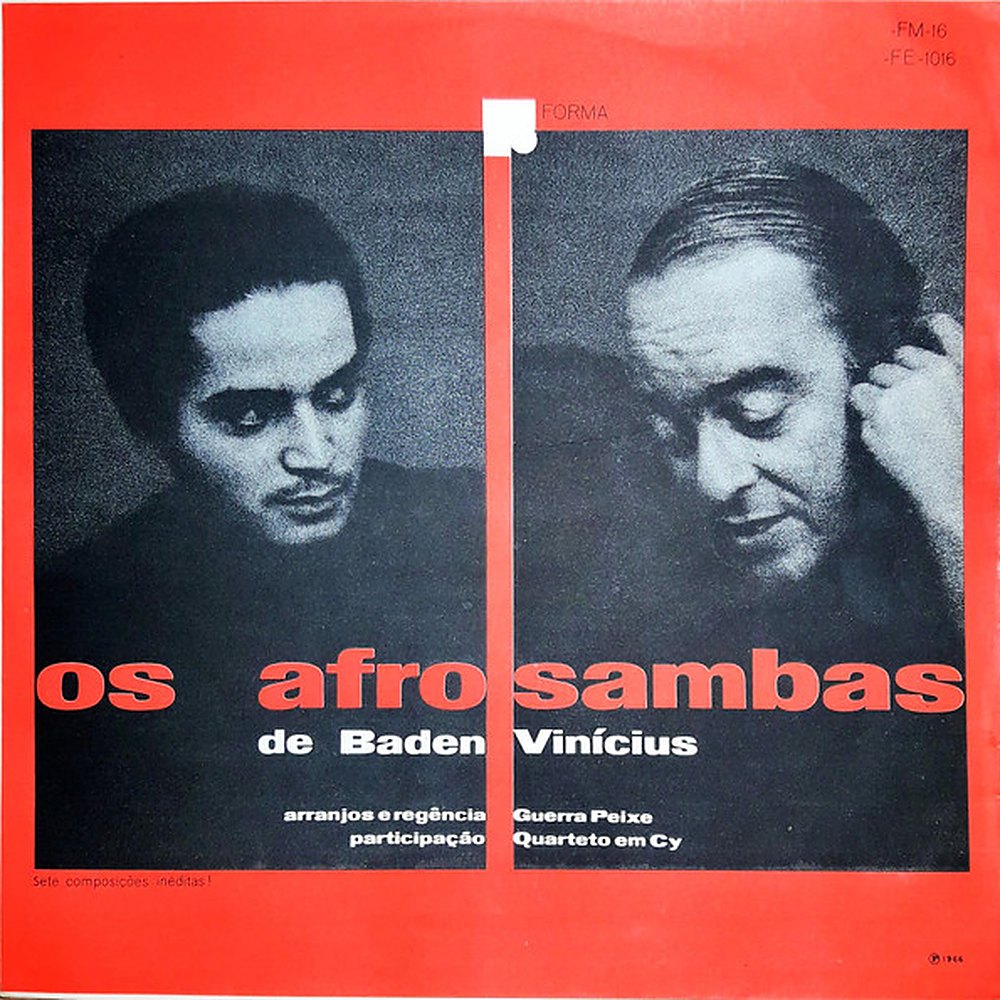
Os Afro-Sambas, by the guitarist Baden Powell and the poet Vinicius de Moraes, began with a gift: a record brought from Bahia. On its way to the studio, the story picked up a classical conductor and a choir of friends.
01A record from Bahia
In the early 1960s the Bahian composer Carlos Coqueijo brought his friend Vinicius de Moraes a record from Bahia. It was a live recording, a mix of sambas de roda, songs from candomblé (the Afro-Brazilian religion) and berimbau, a musical bow with a single string. Researchers believe it was Sambas de Roda e Candomblés da Bahia, featuring the candomblé priestess Olga de Alaketu and Mestre Bimba.
At the time, Vinicius and Baden had started writing songs together in earnest. Vinicius said the two of them spent about three months barely leaving the house, absorbed by the music on that surprise record. Everything suggests it was one of the main inspirations for the album that came next.
02Baden in Salvador
Early in the partnership, Baden went to Salvador to see candomblé up close, and spent time with people who knew it from the inside. In a 1965 newspaper column, Vinicius wrote that his partner came back "completely taken over by the songs and rites of the orixás", the deities of candomblé. Like the other quotes in this story, that line is our translation from the Portuguese.
03The conductor: from the avant-garde to maracatu
For the arrangements and the conducting, the pair brought in César Guerra-Peixe, a conductor Baden was studying with. A classically trained violinist, Guerra-Peixe had started out in the avant-garde, writing twelve-tone music, before changing direction. From 1949 he spent about three years in Recife researching popular music, such as maracatu and xangô. Xangô is the Afro-Brazilian religion of that region, similar in some ways to candomblé.
04The choir of friends
Vinicius wanted a spontaneous record. On the back cover, he wrote that the idea was to record "with a maximum of creative freedom and a minimum of commercial interest".
To "deprofessionalise" the session, he put together what he called the "Coro da Amizade", the Friendship Choir, made of hand-picked friends. They included Tereza Drummond, Otto Gonçalves Filho, Vinicius's wife Nelita, and Eliana Sabino, daughter of Fernando Sabino. The actress Betty Faria sang too, with a solo answering Vinicius on "Canto de Ossanha".
Vinicius recalled arriving at the session one day to find a psychiatrist, César Augusto, conducting the choir. There was no ceremony about it: he was still in his white coat, just as he had come from his hospital shift.
05Recorded in the January heat
The recording took place in early 1966, in the January heat, as Vinicius noted on the back cover. Years later, Baden remembered that on one of those days a storm broke, water flooded the studio and the musicians played sitting on beer crates.
The album came out on Forma, a small, short-lived label. At the time, it sold little.
In 1990 Baden recorded the album again, this time singing himself. He called on the vocal group Quarteto em Cy and added three tracks. Vinicius had died in 1980.
06Words left behind
In the late 1990s, Baden became an evangelical Christian.
In 1999 he gave an interview to the newspaper Folha de S.Paulo and was asked whether he would record the afro-sambas again. "I would. Only some I can't record, right?", he replied.
As an example he named "Samba da Bênção", which is not on the album, and the word "saravá", a greeting from Afro-Brazilian religions that is sung in it: "I can play 'Samba da Bênção', but I don't say saravá, because it is praise of Satan."
In the same conversation, Baden said the afro-sambas were not music made for candomblé: "It's a matter of culture." He also said he did not criticise those who sang the songs, and he praised the recent recordings by Paulo Bellinati and Mônica Salmaso.
Sources & References (12)
- 1.Vinicius de Moraes, back cover text of Os Afro-Sambas (Rio, February 1966), transcribed in Isabela Martins de Morais e Silva, "É, não sou: ensaios sobre os afro-sambas no tempo e no espaço" (opens in a new tab). Master's dissertation, UNESP Araraquara, 2013 (annex, pp. 244-247; also quotes Baden's memory of the recording from Dominique Dreyfus, "O Violão Vadio de Baden Powell")
- 2.Pedro Alexandre Sanches, "Evangélico, músico não diz mais 'saravá'" (opens in a new tab). Folha de S.Paulo, 13 July 1999
- 3."Baden Powell: morre aos 63, no Rio, o mestre do violão" (opens in a new tab). Folha de S.Paulo, 27 September 2000
- 4.Túlio Ceci Villaça and Leon Navarro, "Intuitivo, impreciso, fundamental: Os Afro-sambas" (opens in a new tab). Revista SEDA, v. 7, n. 15, 2023
- 5.Lucas Brêda, "Filme mostra 'Afro-sambas' como resultado de 'pesquisa séria' de Baden e Vinicius" (opens in a new tab). Folha de S.Paulo, 24 June 2025
- 6.Ariel Fagundes, "A genealogia oculta dos 'Afro-Sambas'" (opens in a new tab). Noize, 19 October 2023 (quotes Vinicius's 1965 column "Meu parceiro Baden Powell")
- 7.Isabel Cristina Martins Guillen, "Guerra Peixe e os maracatus no Recife" (opens in a new tab). ArtCultura (UFU), v. 9, n. 14, 2007
- 8."Guerra-Peixe" (opens in a new tab). Dicionário Cravo Albin da Música Popular Brasileira
- 9."Os Afro-sambas" (opens in a new tab). Dicionário Cravo Albin da Música Popular Brasileira
- 10."Os Afro-Sambas de Baden e Vinicius" (opens in a new tab). Enciclopédia Itaú Cultural
- 11.Marcos Sampaio, "O batuque de fé dos afro-sambas" (opens in a new tab). O Povo+, 16 July 2022
- 12.Os Afro-Sambas de Baden e Vinicius (Forma, 1966) (opens in a new tab). MusicBrainz
Spotted an error? Tell us →